Where? Domsten-Sofiero Length: 6.5 km. Difficulty: Moderate
The hike follows Skåneleden Trail’s sub-trail SL5 – the Öresundsleden Trail – along the coastline from Domsten down towards Helsingborg. Get off at the Domsten Väg 111 bus stop, cross route 111 south towards Domsten and turn west down towards the beach past a wind shelter. Once you have found the first orange trail marker, start hiking south.
If you are hiking here in the summer, you can admire Helsingborgs campingklubb south of Domsten. It is one of a kind and does not look like any ordinary campground – from May to October it is home to fifty-some small, collapsible masonite houses that are white with a green roof. The campground opened in 1933 (at that time, with sites for tents), but gradually developed into a home for a more comfortable camping life. During the cold time of year, the campground seems to only be colourful decorations in cement slabs on the ground.
You continue along soft woodland paths and can now make a detour to the Kulla Gunnarstorp a bit inland. The estate dates back to the 1400s, when it was known as Gundestrup. Its first owner is said to be the knight Jens Olofsen Lunge. The estate is located in its own nature reserve, with forests, trails, farmland, and burial mounds from the Bronze Age. The coastline below Kulla Gunnarstorp was formed just after the ice age and is known as “Scandinavia’s most beautiful post-glacial coastline”.
The oldest parts of Kulla Gunnarstorp are its castle and moats from the Middle Ages. The castle was built on the initiative of Jörgen Ottesen Brahe – brother of the astronomer Tycho Brahe – during the second half of the 1500s. Jörgen Ottesen Brahe played an important role in the Danish court and participated in festivities such as the crowning of Scottish Queen Anne in Edinburgh in 1590. Both Brahe and his wife died of the plague in 1601 and are buried in Allerums Kyrka just a few kilometres away.
When Carl Linnaeus visited Kulla Gunnarstorp on his trip to Skåne in 1749, he was impressed by the useful splendour of the garden, which grew almonds, apricots, walnuts, Spanish cherries, pears and Malus apples. There were also trellises of pumpkins. He also described the boxwood hedges of the estate by saying: “so magnificent; I’ve never seen anything so glorious in all my travels”.
The castle itself was built between 1865 and 1868 and was designed by Danish architect Christian Zwingmann, who also restored Marsvinsholm Castle outside of Ystad. Architecturally, Kulla Gunnarstorp is a mixture of Christian IV Renaissance and Italian classicism. The red brick castle spans three floors, with pinnacles, towers and roof terraces. The red-finished old castle is surrounded by a moat. There are also large greystone agricultural buildings, worker cottages, gatekeeper’s building and stables.
South of the castle is the Kulla Gunnarstorp Mill – one of the oldest and largest windmills in Skåne. It differs slightly from other mills because it has a rotatable “boat cap” at the top, which enables the wings to rotate for the best wind direction. The mill was built between 1790 and 1798, and was taxed as a customs mill in 1809. It was in operation until 1950, was declared an historical landmark in 1991, and is currently owned and operated by Kullens hembygdsförening.
You pass the tiny community of Laröd –originally a farmer’s village, but now a housing development – and start getting closer to Sofiero Palace when you suddenly come across a totem pole at the edge of the beach. It looks a bit scary and represents a killer whale. The bottom part looks like an owl it transitions to a thick, oar-like tip at the top.
The totem pole is made of a four hundred-year-old Canadian red cedar and is intended to protect Sofiero and serve as a symbol to welcome seafarers. In some Indian tribes, totem poles were positioned at the water in just this way.
The pole is part of a sculpture park at the palace, and is a work of art created in 1990 by the artist, totem master and Haida Indian Jim Hart and his assistant Paul White. The totem pole was carved using old-fashioned traditional axes and knives, and the red cedar wood comes from the artist’s home on an island in British Columbia on the west coast of Canada.
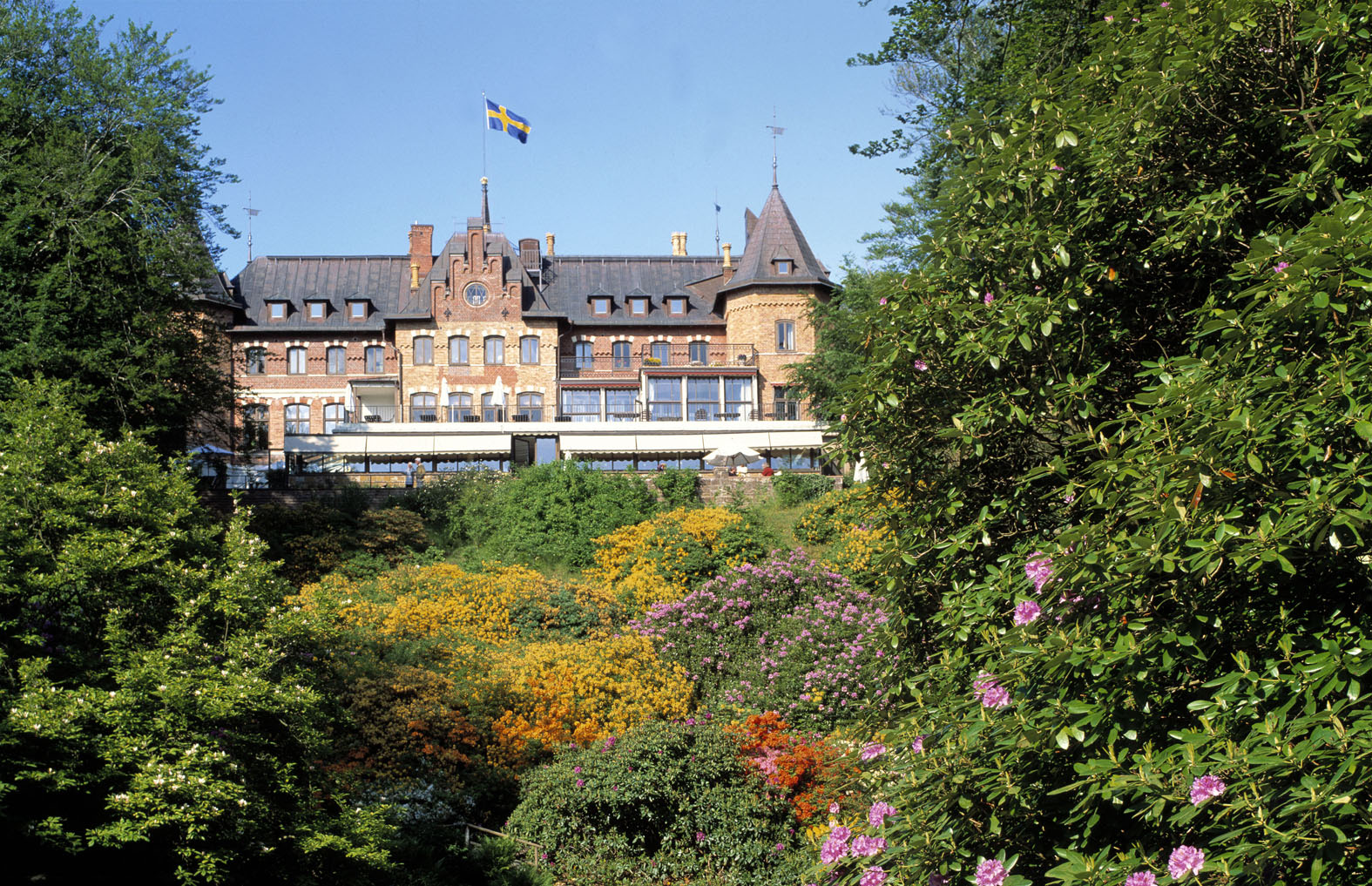
The royal summer palace Sofiero is known for two things – its magnificent gardens filled with rhododendron, and its history as the summer residence of Gustav VI Adolf. The palace was built in the 1860s by then Crown Prince Oscar and his wive Sofia of Nassau – hence the name Sofiero. The couple had visited the area and fell in love with its nature, its view and its proximity to Copenhagen. The palace was originally called Skabelycke, and the royal couple moved in in 1866.
When Oscar’s grandson – the major garden enthusiast Gustaf Adolf – married English Margareta in 1905, the couple was given the palace as a wedding present. They had ambitious plans for the garden, and over 15 years transformed it into a magnificent palace garden up until Margaretha’s death in 1920. The widower Gustaf Adolf was left alone with five children, but married Lady Louise Mountbatten in 1923.
Gustav VI Adolf (the grandfather of our present-day king Carl XI Gustaf) was crowned king in 1950 and died in Helsingborg in 1973. Today, flower lovers flock to Sofiero to see the flowers in all their splendour. Margareta brought with her influences from England, and the first rhododendron was planted in 1907. Today, there are over 10,000.
The garden is now also home to the dahlia quarter (“dahliakvarter”), the garden of delight (“lustträdgård”) and the kitchen garden (“köksträdgård”). Running along both sides of the palace are two ravines full of deciduous trees – a perfect and shady place that enables the rhododendrons to thrive. In 1973, the palace was willed to the City of Helsingborg.
Jump on the bus at the Laröd Sofiero bus stop on the road called Gamla Larödsvägen. There is also a bus stop on the road Sofierovägen at the main entrance.